
Lab · Experiment
Flow field
Visuals · Ready to explore
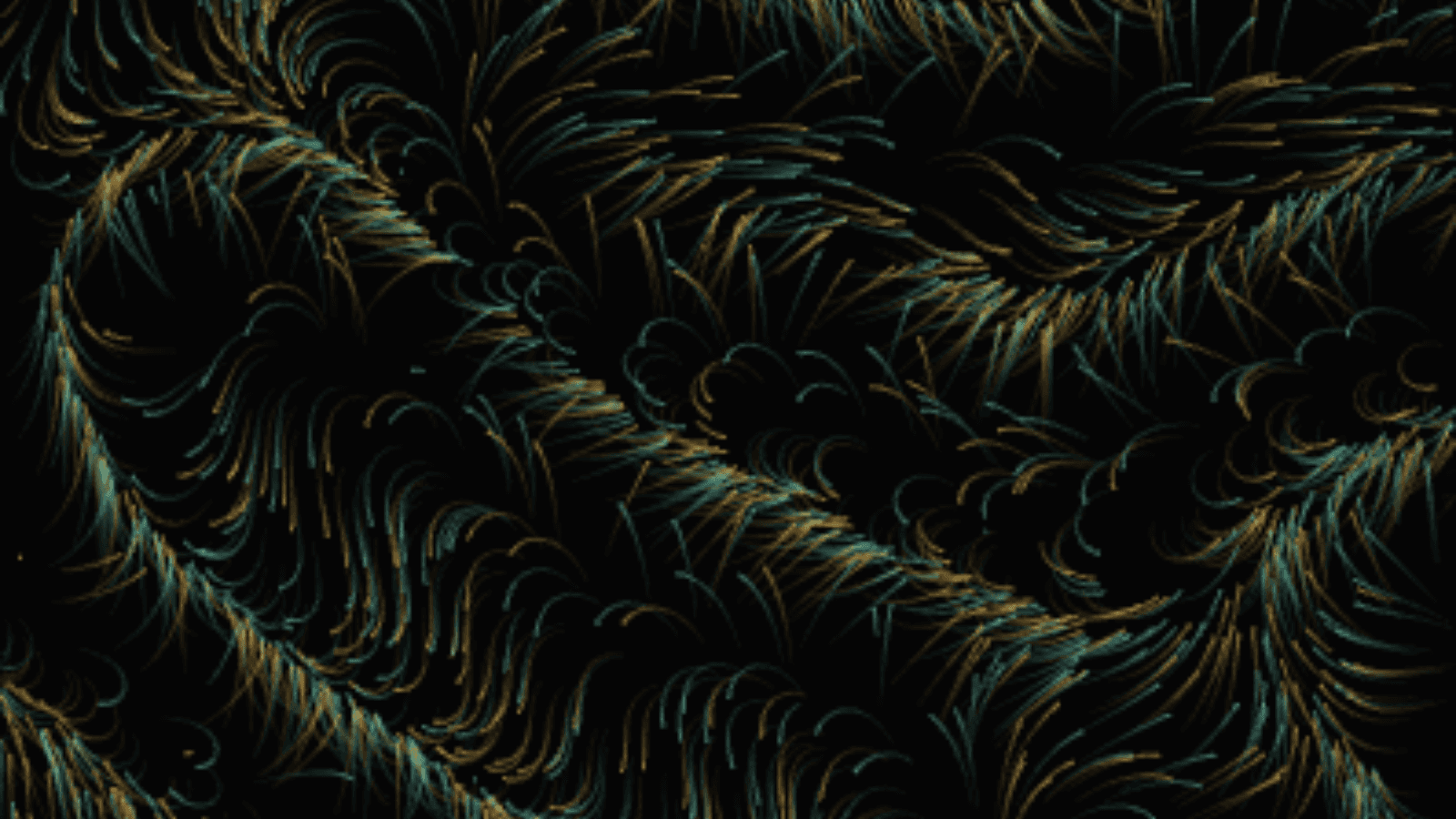
Thousands of particles follow an evolving noise field and leave trails of light.
Try this
Drag across the canvas to stir the flow, then play with the particle count and the trail length.
The idea, and what I learned
The question: how much structure can you get from almost no rules? Each particle only asks one thing — which way does the field point here? — and moves a little in that direction.
The field comes from gradient (Perlin) noise, sampled at the particle's position and slowly scrolled over time, so the currents drift and reform. Stirring adds a temporary swirl around the pointer. Each frame is covered with a translucent dark layer instead of being cleared, which is what turns positions into trails.
What I learned: the whole look lives in two numbers, the noise scale and the trail fade. It's the same particle-and-field idea as this portfolio's background, stripped down to a 2D canvas so every step is visible.
Walkthrough, without running it
- The canvas starts dark and fills with 1,600 particles at random positions.
- Every frame, each particle reads the noise field where it stands, turns that value into an angle and moves a few pixels that way.
- Neighbouring particles read almost the same angle, so they travel together and draw long, curling streams — like wind on a weather map.
- A particle that leaves the canvas reappears at a random spot, which keeps the density even.
- Dragging adds a vortex around the pointer: the streams bend into a spiral for a moment, then relax back into the field.
- A short trail makes the image look like moving dots; a long one turns it into smooth ribbons of light.